
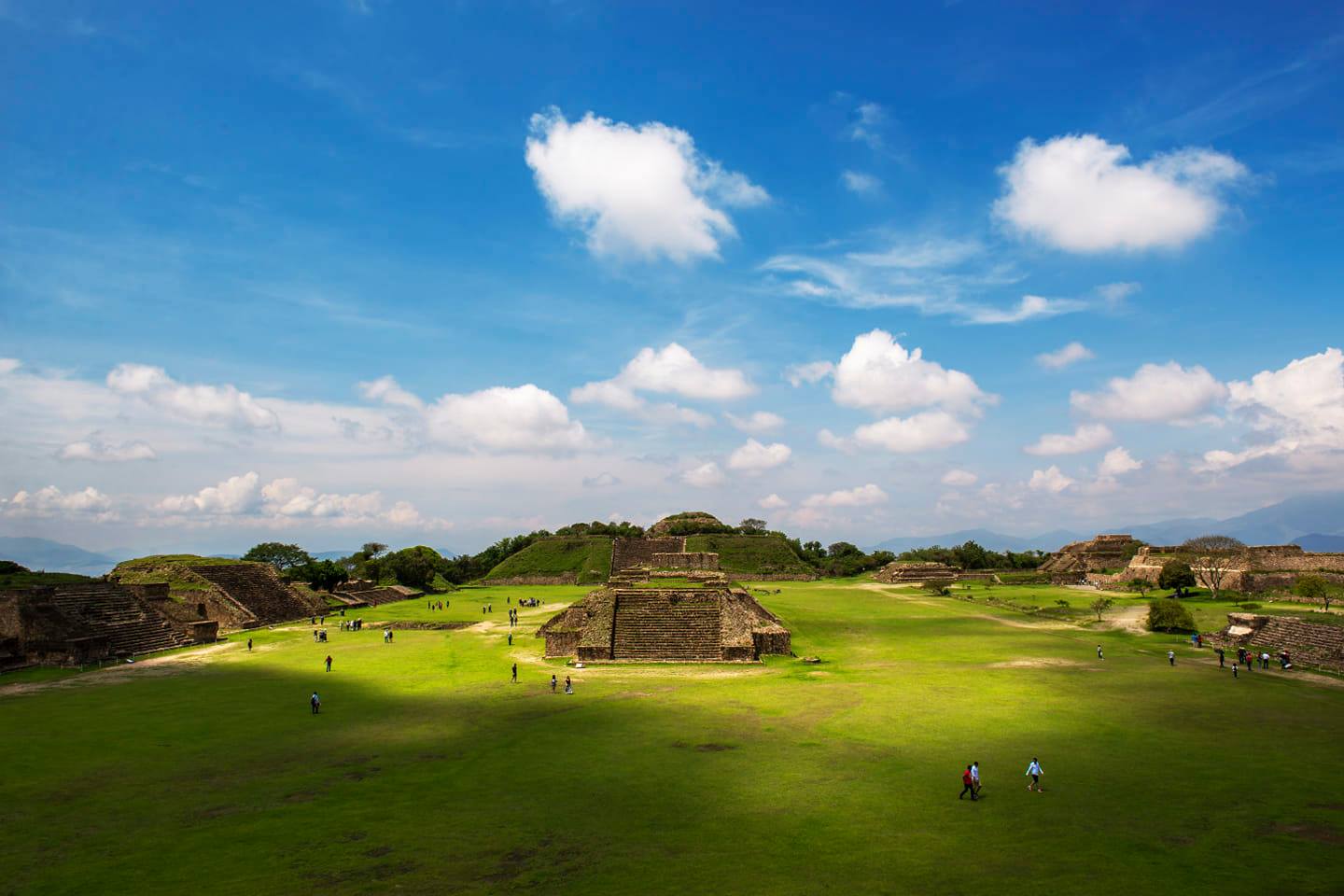
Monte Albán was the ancient capital of the Zapotecs and one of the first cities of Mesoamerica and more populous during its century, it was founded approximately 500 years BC, flourishing up to 750 D.C.
Located in the center of the Valley of Oaxaca, Monte Albán exerts political, economic and ideological control over other communities in the valley and the surrounding mountains. Its main buildings: The Great Plaza, Ball Game, System II, The Dancers, Building J, Central Buildings G. H. I., The Palace, South Platform, System 7 Deer and Tomb Number 7.
The Great Plaza. It is 200m long by 200m wide, so the rocky outcrops had to be cut, and some gaps filled.
Ball Game: Located to the left of the entrance to the Great Plaza, it has the characteristics of the ball games of the region. This field is delimited by two structures on the sides with a rectangular base, with a very inclined slope; the one on the east has a sculpture representing a “chapulín” (grasshopper) on the top, the platform located to the west has a staircase, flanked by two alfardas ending in a slope, with two steles on the top, in the corners of the heads there are two small niches.
System II. Is a two-body structure with a staircase, flanked by two alfardas, ending in a slope and double scapular boards. On the top there is a small temple of rectangular base with five columns in front and as many in the back without side walls; to the south of this element there is a tunnel roofed with angular vault that connects us with the central buildings.
The Dancers. This three-body building belongs to the III B period, with slope walls covered with sculpted tombstones with representations of human figures in very strange positions and with physical features characteristic of Olmec sculpture.
Building “J”. It is separated from the other buildings, is undoubtedly one of the most interesting, due to its orientation and shape. It resembles an arrowhead, it has two bodies, its staircase is oriented towards the northwest, its walls are vertical, covered with tombstones with inscriptions, it is believed that the previous chamber was used for astronomical observations, but this is not proven; this building belongs to the II period.
Central Buildings G. H. I. These buildings are located in the central part of the Great Plaza. The central building "H" is the largest, it has two bodies, with a large staircase, two tombs and the temple at the top with two chambers and two columns at the entrance, very close to the side walls. It is believed that this building belongs to the III A period, and it continued to be used at the end of the III B period. In front of the main staircase there is a small temple with a quadrangular base, in which the famous mask of the Bat God, made of jade, was found.
The Palace. It is a structure made up of two bodies, with a central staircase, with alfardas finished in the shape of a slope, it has 13 rooms grouped around a central patio at the top, on the access door to this set there is a recently placed lintel.
South Platform. South Platform: It is a very large structure that closes the plaza on that side. With two bodies, at the top there are two mounds, from this place you can completely observe the Great Ceremonial Plaza. In the lower part of this and in the corners there are several stelae embedded with reliefs of zoomorphic figures, as well as some offerings.
System 7 Deer. To get to this place it is advisable to walk on the upper part of the southern platform, towards the southeast, which is located about 250 m. away off the Main Plaza. There are four structures around a plaza oriented towards the four cardinal points.
Tomb No. 7. When exploring it on January 6, 1932, the Mexican archaeologist Dr. Alfonso Caso, found a burial with a rich amount of offerings, considered a great archaeological treasure, which is exhibited in the Museum of Cultures. The layout of the tomb has a rectangular base, made up of an antechamber and a chamber with an angular vault cover. It is one of the few that have been found, although it has already deteriorated, with its offerings intact.
Gallery


Location Map


